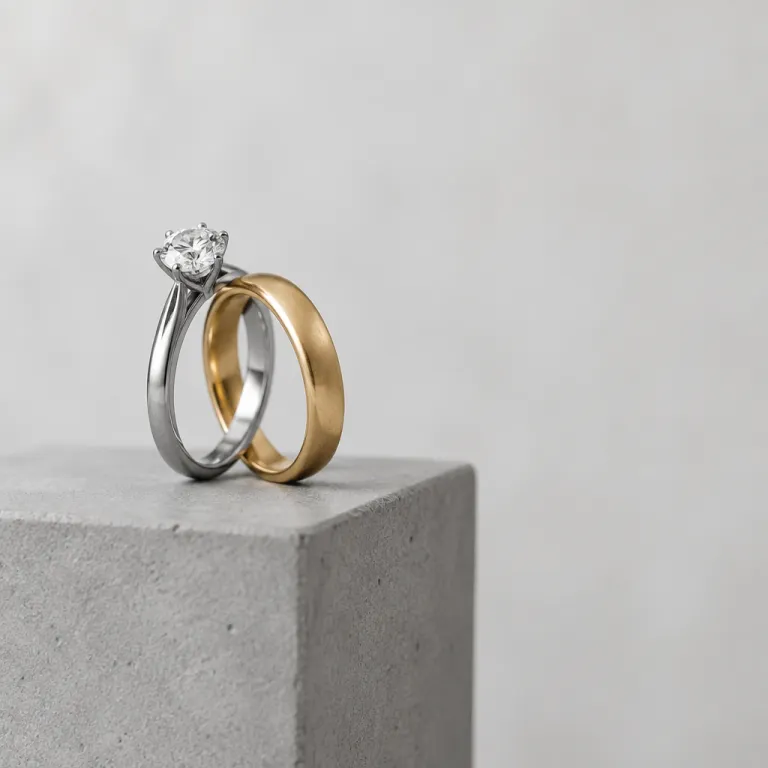
The geometry of a balanced engagement ring and wedding band pairing
A well-balanced engagement ring and wedding band combination depends on proportion, profile, and curvature. Think of your bridal jewellery as a tiny piece of architecture for your hand: the diamond shape, band width, and setting height all work together to create a harmonious wedding ring stack rather than a single isolated ring.
Your engagement ring and wedding band relationship lives or dies on geometry. A 1.5 carat round brilliant diamond on a 1.8 millimetre band behaves very differently beside a 4 millimetre eternity band. The same centre stone can look delicate and airy with a slim companion ring, or bold and graphic with a wider band that visually anchors the diamond.
Start with width. If your engagement ring has a very slim gold shank, a wedding band that is the same width creates a traditional bridal set, while a slightly wider band adds a modern, grounded feel without overwhelming the cut diamond. Many couples upgrading wedding rings find that a bold 3 to 4 millimetre band in yellow gold or platinum suddenly makes an older engagement ring look intentional again.
| Band width | Best for finger size* | Visual effect in a stack |
|---|---|---|
| 1.5–2 mm | Very small to medium | Delicate, airy, ideal for three-ring stacks |
| 2–3 mm | Small to large | Balanced, classic, easy to mix with eternity bands |
| 3–4 mm | Medium to large | Bold, contemporary, makes centre stone feel more substantial |
*Jewellers often use these ranges as a starting guideline, then adjust for hand shape and personal taste.
Profile matters just as much as width. A low profile engagement ring setting with a bezel or flush set round diamond sits close to the finger and usually pairs best with straight bands, while a high cathedral setting or emerald cut diamond on tall prongs often needs a contoured band to nestle without knocking. When you test engagement rings with different bands, look from the side to see whether the ring features align or fight each other.

Curvature is the final geometric lever. A straight eternity ring creates a clean, graphic line beside a solitaire, but a gently curved wedding band can hug the centre stone and visually pull the set together. If your engagement ring has an elongated cut engagement shape such as an emerald cut or oval, a very tight contour can lock you into one exact band, so consider a softer curve that still allows future bands to stack.
Metal mixing and budget smart choices for engagement ring and band sets
Metal colour is where engagement ring and wedding band pairing gets interesting. Matching yellow gold rings feel cohesive and traditional, while a white gold engagement ring with a rose gold wedding band can look deliberately modern and layered. The key is repeating at least one element, such as metal colour, finish, or diamond size, so the set feels like one thought rather than two random rings.
If you are planning or upgrading on a budget, mixed metal wedding bands can be a smart way to stretch your spend without sacrificing quality. A slim platinum engagement ring with a polished yellow gold band often costs less than a full platinum bridal set, yet the contrast makes the diamond engagement stone appear whiter and brighter. For more detailed guidance on finding coordinated but affordable wedding ring sets, see this resource on budget friendly wedding ring sets.
Think about your personal style and wardrobe. If you wear mostly warm tones, a yellow gold eternity band beside a white gold engagement ring can bridge your jewellery and clothing, while a rose gold ring wedding stack adds softness and romance. Couples who prefer a very modern style often choose platinum or white gold bands with minimal pave diamonds, then add one textured gold band later for depth.
Longevity should guide metal choice as much as aesthetics. Platinum is denser and naturally white, so a platinum wedding ring will keep its colour without rhodium plating, while white gold bands need periodic maintenance to stay bright. Independent gemmological institutes and trade bodies note that platinum’s higher density also makes it more resistant to metal loss over decades of wear, while gold alloys can gradually abrade and thin with daily friction. When you shop for engagement rings and wedding bands, ask to compare the same ring features in 14 carat and 18 carat gold and in platinum, then weigh how each feels on your hand over several minutes. Many gemmologists and bench jewellers recommend trying sample bands for at least a few minutes to notice weight, balance, and comfort before deciding.
Texture, setting, and the art of contrast in ring stacks
Texture is the secret weapon in a sophisticated engagement ring and wedding band pairing. A high polish engagement ring with a round brilliant diamond can look almost too perfect until you add a brushed or hammered band that breaks the shine in a controlled way. That contrast lets each ring breathe while still reading as one wedding set.
Look closely at your engagement ring setting before choosing bands. If you have a pave diamond engagement ring with micro pave along the shank, a plain metal wedding band gives the eye a place to rest, while a matching pave eternity band turns the whole stack into a continuous ribbon of diamonds. When both rings have pave diamonds, keep the stone size and cut diamond shape consistent so the bands feel related rather than noisy.
Stone shape also drives texture. A solitaire emerald cut engagement ring with a sleek step cut diamond pairs beautifully with a channel set eternity band of baguette diamonds, because the linear facets echo each other, while round brilliant diamonds in a scalloped setting soften the geometry for a more romantic style. For couples who like vintage inspired wedding rings, mixing a milgrain edged band with a clean modern engagement ring can create a curated, collected over time look.
Matching sets are safe, but they can feel flat for an anniversary upgrader who now knows their personal style. Instead of buying a pre made bridal set, build your own by pairing a slim rose gold band with a platinum engagement ring, then adding a delicate eternity ring later. For more ideas on coordinated but not identical wedding bands, explore this guide to matching wedding band sets that still leave room for individuality. Many jewellery designers note that this mix-and-match approach often results in stacks that feel more personal and timeless than rigidly identical sets.
Contour bands, gaps, and when custom makes sense
Not every engagement ring wants to sit flush with a straight wedding band. East west settings, asymmetric halos, and low bezel rings often leave a visible gap when you slide on a standard band, and that can either bother you or become a design feature. The question is whether the space looks intentional in your wedding ring stack.
Contour bands are shaped to curve around the centre stone or halo of an engagement ring. A gentle contour works well with round or oval engagement rings, while a sharper V shaped band can frame an emerald cut or marquise cut engagement stone like brackets, turning the two bands into one graphic element. If you choose a contoured eternity band, remember that the curve locks you into that exact engagement ring geometry, which can limit future upgrades.
Sometimes the gap is the point. A slim platinum wedding band sitting 1 to 2 millimetres away from a yellow gold engagement ring can create a clean negative space that highlights both rings, especially when one is a full eternity ring and the other is a plain band. Couples who like a modern style often lean into this, using the gap to separate textures such as heavy pave diamonds and a brushed metal ring.
Custom work becomes worth the investment when nothing off the shelf respects your engagement ring features. If your ring design has an unusual under gallery or a very low cut engagement setting, a bespoke band can follow the exact curve while keeping diamonds secure and comfortable. When you commission a custom eternity band or bridal set, ask the jeweller to 3D print a prototype so you can test the stack for a week before committing to the final metal and diamonds. Many custom workshops now rely on CAD models and resin samples so you can assess how the rings behave in real life before you approve the final piece.
How to test pairings and three example stacks that actually work
Trying on bands for five rushed minutes under jewellery store lights is not enough. Ask to wear your preferred engagement ring and wedding band pairing while you fill out paperwork or walk near a window, because daylight reveals how the diamonds and metals really interact. If possible, visit the shop twice at different times of day so you see the wedding ring stack in both bright and softer light.
When you test, move beyond the top view. Rotate your hand, lace your fingers, and check how the engagement ring setting and wedding bands feel between your fingers, because sharp edges or tall prongs can become irritating in daily wear. This is also the moment to think about which hand will carry which ring and how that aligns with your cultural or personal symbolism, and you can read more about a meaningful choice of hand in this guide on which hand to wear a wedding ring on.
Now to three real world stacks. For a classic style, pair a round brilliant diamond engagement ring in platinum on a 2 millimetre band with a matching 2 millimetre platinum wedding band and a very slim pave eternity band in the same metal, which keeps the look traditional but lets you dial up or down the sparkle. For a modern stack, try an emerald cut diamond engagement ring in yellow gold with a 3 millimetre brushed yellow gold band and a 2 millimetre platinum eternity ring, using the mixed metals and textures to frame the clean cut diamond.
For a vintage leaning bridal set, start with a rose gold engagement ring featuring a round cut engagement diamond in a milgrain halo, then add a curved rose gold eternity band with tiny round diamonds and a very slim yellow gold band for contrast. This three ring wedding combination layers colours, textures, and cuts while still reading as one intentional set. In the end, what matters is not the certificate, but how it catches light on a Tuesday morning.
FAQ about engagement ring and wedding band pairing
How wide should my wedding band be compared with my engagement ring
A good starting point is to keep your wedding band within about 0.5 to 1 millimetre of your engagement ring width. If your engagement ring band is very slim, matching the width creates a traditional look, while choosing a slightly wider band adds a modern, anchored feel. Try different widths in person, because finger size and hand shape change how the proportions read.
Can I mix metals between my engagement ring and wedding bands
Yes, mixing metals can look intentional and sophisticated when done thoughtfully. Repeat at least one element, such as matching the finish or diamond size, so a yellow gold band and platinum engagement ring still feel related. Many couples choose a white metal for the engagement ring and a warm metal for the wedding ring to bridge different jewellery in their wardrobe.
Do my engagement ring and wedding band need to sit perfectly flush
They do not need to sit perfectly flush unless that is your personal preference. A small gap between the engagement ring and band can create a clean negative space that highlights each ring, especially in modern stacks. If the gap bothers you or causes the rings to spin, a contoured or custom band can solve the issue.
Is an eternity ring practical for everyday wear beside an engagement ring
An eternity ring offers continuous sparkle but can be less practical for very active lifestyles. Diamonds all the way around mean more exposed stones that can knock against surfaces, especially when stacked tightly with an engagement ring and wedding band. Many independent jewellers and repair specialists suggest a half eternity band for daily wear and reserving a full eternity ring for special occasions or gentler use.
How do I know if a contoured band is right for my engagement ring
A contoured band is helpful when your engagement ring has a low setting, a large halo, or an unusual shape that prevents a straight band from sitting close. If a straight band leaves a large or uneven gap, try gentle and more dramatic curves to see which respects your ring features. Choose a contour that still allows some flexibility for future bands if you plan to build a larger stack over time.